Insights
What does an incubation team look like?
8 minute read
8 minute read
It looks much like a typical Product Development team, but their personalities are very different.
It looks much like a typical Product Development team, but their personalities are very different.
An incubation team at the outset looks a lot like a typical Product "triangle team":
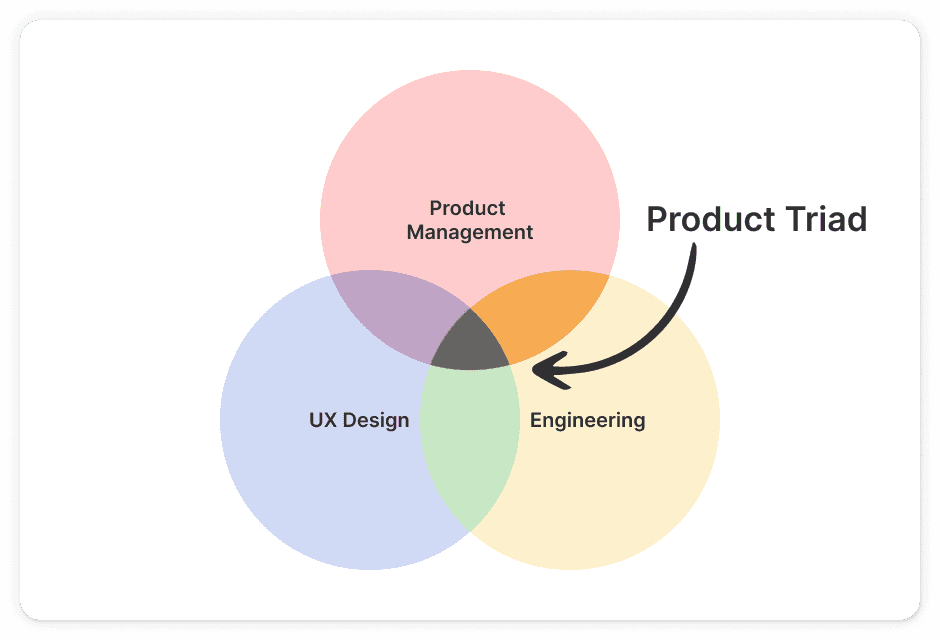
Product & Team Lead: Like a Product Manager on a development team, they are focused on ensuring the incubation team’s product(s) meet the needs of customers in a financially viable manner. And like a good PM, they lead the incubation team through influence – ensuring the team is fully bought in on the direction – rather than through authority. However, it should be clear that they are ultimately the key decision-maker on the team because they have overall ownership and responsibility of the “startup”, accountable to the larger corporation (the “investors”).
These individuals may in fact not be very good at leading a product through launch, but they excel at the fuzzy front-end of the product development stage – when you’re unsure of the feature-set, the benefits sought, the business viability, and the technical risk. They love solving those problems, and this will be the entire environment of an incubation effort. But they may not be as engaged in later stages when you’re on the development and testing path through launch.

Development Lead: The second leg of the triangle is the development lead. Like a lead engineer on a product team, they are primarily responsible for technical delivery. But unlike a product development lead, the incubation development lead is focused on unlocking rapid learning. They are not concerned about refined quality development, or tech debt, or cost of ownership. They’re looking for short-cuts to get to a prototype faster so the team can learn faster. They’re hackers, not engineers. In fact, one of the best I’ve ever seen in this role was not a professional engineer at all – they were a technician that worked on product displays. But they were extremely resourceful and clever and could build you one of anything you wanted.
User Research Lead: The final leg of the triangle is the User Research lead. On a typical product team, this person would be mostly working on the UX and testing/validating it with users. On an incubation team, they’re further upstream using similar skills to uncover core needs, understanding the users deeply. After all, this world is (or should be) largely unfamiliar to the company! This individual leads the incubation team on interviews and site visits and leans heavily on observation to glean insights for the team. They may not do product design at all in fact.
There’s a lot of debate about the extent to which these individuals must have explicitly entrepreneurial experience. In my experience, this isn’t necessary so long as the person is “entrepreneurial-minded”:
They think holistically about a problem
They like to take smart risks
They have grit to persevere,
But also demonstrate a willingness to learn and pivot
And, yes, there are often these types of folks in larger companies – you just need to suss them out. How? One of the best ways is to actively promote the incubation team and let them come to you! They will be more naturally attracted to this kind of opportunity. This also speaks to the benefit of having an internal leader own the incubation function – they have a network within the company that they can draw upon.
When I was at Bose, team members came from both directions: Some were internal transfers and some were outside hires from other companies, and one was a serial entrepreneur. In this limited experience, the only failed hire we had was in fact the entrepreneur. This makes sense if you think about it: While they have all the qualities we need, they may not be effective at managing inside a larger organization with explicit and perhaps narrow goals for the incubation.
An incubation team at the outset looks a lot like a typical Product "triangle team":
Product & Team Lead: Like a Product Manager on a development team, they are focused on ensuring the incubation team’s product(s) meet the needs of customers in a financially viable manner. And like a good PM, they lead the incubation team through influence – ensuring the team is fully bought in on the direction – rather than through authority. However, it should be clear that they are ultimately the key decision-maker on the team because they have overall ownership and responsibility of the “startup”, accountable to the larger corporation (the “investors”).
These individuals may in fact not be very good at leading a product through launch, but they excel at the fuzzy front-end of the product development stage – when you’re unsure of the feature-set, the benefits sought, the business viability, and the technical risk. They love solving those problems, and this will be the entire environment of an incubation effort. But they may not be as engaged in later stages when you’re on the development and testing path through launch.
Development Lead: The second leg of the triangle is the development lead. Like a lead engineer on a product team, they are primarily responsible for technical delivery. But unlike a product development lead, the incubation development lead is focused on unlocking rapid learning. They are not concerned about refined quality development, or tech debt, or cost of ownership. They’re looking for short-cuts to get to a prototype faster so the team can learn faster. They’re hackers, not engineers. In fact, one of the best I’ve ever seen in this role was not a professional engineer at all – they were a technician that worked on product displays. But they were extremely resourceful and clever and could build you one of anything you wanted.
User Research Lead: The final leg of the triangle is the User Research lead. On a typical product team, this person would be mostly working on the UX and testing/validating it with users. On an incubation team, they’re further upstream using similar skills to uncover core needs, understanding the users deeply. After all, this world is (or should be) largely unfamiliar to the company! This individual leads the incubation team on interviews and site visits and leans heavily on observation to glean insights for the team. They may not do product design at all in fact.
There’s a lot of debate about the extent to which these individuals must have explicitly entrepreneurial experience. In my experience, this isn’t necessary so long as the person is “entrepreneurial-minded”:
They think holistically about a problem
They like to take smart risks
They have grit to persevere,
But also demonstrate a willingness to learn and pivot
And, yes, there are often these types of folks in larger companies – you just need to suss them out. How? One of the best ways is to actively promote the incubation team and let them come to you! They will be more naturally attracted to this kind of opportunity. This also speaks to the benefit of having an internal leader own the incubation function – they have a network within the company that they can draw upon.
When I was at Bose, team members came from both directions: Some were internal transfers and some were outside hires from other companies, and one was a serial entrepreneur. In this limited experience, the only failed hire we had was in fact the entrepreneur. This makes sense if you think about it: While they have all the qualities we need, they may not be effective at managing inside a larger organization with explicit and perhaps narrow goals for the incubation.